
The Rover: Bringing Fire Fuels Characterization to the Ground
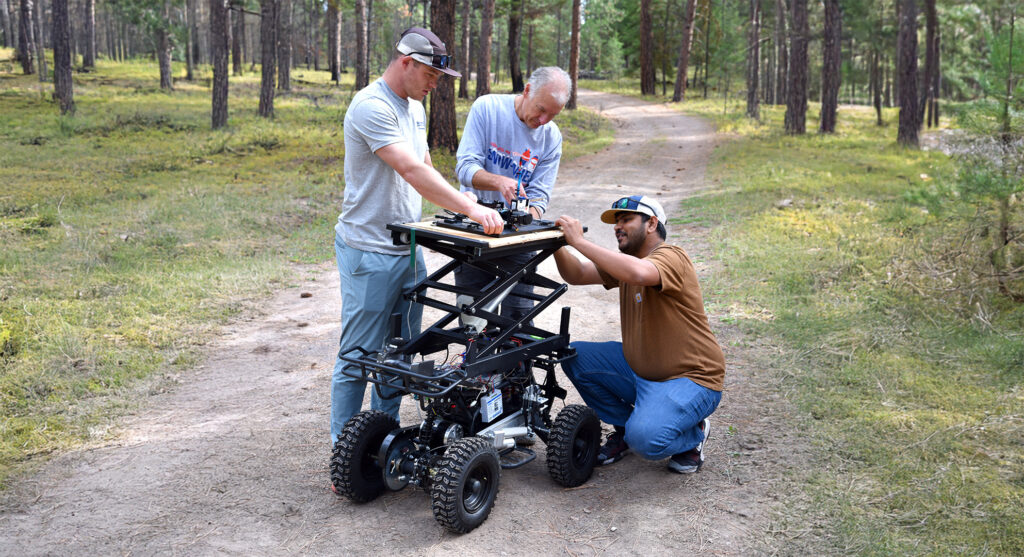
Why did SMART FIRES build a rover?
The SMART FIRES Smart Optical Sensors (SOS) team at Montana State University has been using a hyperspectral camera mounted on a drone to collect forest fuels data. Although this works well above the forest canopy, the team also needed a way to characterize ground fuels. Joe Shaw, SOS Team lead, turned to Tim Price at Flathead Valley Community College (FVCC) to see whether he and his students could build a rover.
How was the rover built?
Tim took the challenge to his Mechatronics students, who began brainstorming a prototype. While sourcing materials, one student found a children’s electric ATV that cost less than building from scratch. The team stripped the vehicle down to its frame and wheels and rebuilt it from the ground up.
Knowing the rover would need to capture vegetation at different heights, they designed an extendable platform that could support a variety of environmental sensors.
How does the rover work?
For now, the rover is operated remotely, but the long-term goal is a fully autonomous system capable of navigating around trees and other obstacles in forested environments.
Nico Carlson and Douglas Marshall, undergraduate computer science students at FVCC, have been involved in the rover’s software development. Together, they created a virtual testing environment, integrated a Raspberry Pi computer to process sensor data, and incorporated LiDAR-based mapping and obstacle detection. These tools allow the team to evaluate and improve the rover’s performance before conducting field trials.
What sensors are being tested on the rover?
The rover serves as a testbed for sensors being developed by the MSU’s SOS team, with data analyzed by researchers on the Artificial Intelligence / Machine Learning (AIML) team.
During a September 2026 deployment at Lubrecht Experimental Forest, the rover carried a LiDAR sensor, hyperspectral camera, spectrometer, and GPS receiver.
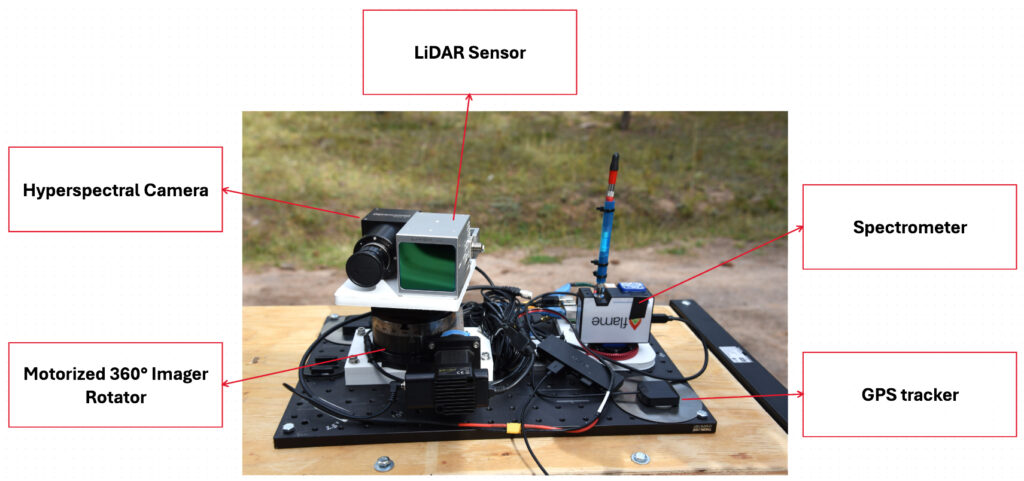
Montana State University graduate students Brandon Mickelson and Mahmad Isaq Karankot were on the ground with Tim Price during deployment. Brandon managed data collection and troubleshooting of the sensor suite. Isaq develops artificial intelligence and machine learning models from the data to classify different fuel types.
Why is the rover important?
The rover brings together expertise from across SMART FIRES, including researchers working on mechanical design, coding, remote sensing, artificial intelligence, and machine learning. Combined with airborne measurements from drones, it will help create a more complete picture of forest fuels from the forest floor to the canopy.
As the project continues to evolve, the rover will provide information that supports prescribed fire planning, management, and assessment while helping researchers better understand and monitor fire-prone landscapes.